My
19-year old daughter Emily Rachel Silverstein was murdered by her ex-boyfriend
on April 9, 2009 at Gettysburg College. It's not anything that she or we could
ever have imagined would happen. Fortunately murders are not very common, but
date violence and abuse is. 1 in 3 teens report that they have experienced
physical, verbal, emotional or sexual abuse. YOU can help raise awareness
about this serious issue, helping young people learn the warning signs
of date abuse, AND even more importantly, know what to do to protect themselves
if they are in an abusive relationship.
After
Emily was murdered, we purposely tried to steer the media and our own thoughts
away from the circumstances of her untimely death by focusing on the life and
legacy of this extraordinary human being. Emily was a compassionate person with
a passion for helping to make the world a better place. At college she grew into
a leader, organizing, inspiring and empowering other young people to become engaged
and involved in many different social issues for a more peaceful, just and sustainable
world. She touched many lives but there is so much more she had wanted to do.
We started The Emily Fund to share her
story in the hopes that other young people would continue to be inspired by her
vision, compassion and passion for a better world.
Although
I want my daughter to be remembered for the wonderful person she was, I also feel
driven to try to do what I can to prevent other young people's lives from being
cut short in the way our daughter's was. In order to figure out how to help, I
set out to try to properly categorize our daughter's murder. From the beginning,
the media called Emily's murder 'domestic violence.' This didn't sit right with
us, since Emily had not been physically abused during her short-term relationship;
they never lived together, and they had broken up weeks before the murder.
As
I began researching 'domestic violence' I discovered there were lots of wonderful
materials and organizations devoted to helping domestic partners escape from an
abusive relationship. It didn't seem to me that these would resonate with the
type of relationships college students were engaged in, though. However, I discovered
there was a whole niche of organizations and materials focusing on "teen
dating violence" too. This sub-niche seemed closer to the category of violence
that took our daughter's life. But, nearly all of these addressed dating violence
among high school students. There didn't seem to be many resources or organizations
addressing dating violence at college -- a time young people away from home could
be most vulnerable. When I spoke to Emily's friends at different colleges around
the country, I heard a similar story -- there was usually a brief 'dating violence
awareness' program during freshman orientation, but then the subject was never
mentioned again.
I
started StopDatingViolence.org, a project of the 501c (3) nonprofit organization
- We, The World, Inc., to provide information, links and resources to young people
at college, in the hope that Emily's story will not only inspire many to become
actively engaged in social change as she was, but also to raise awareness about
the serious issue that ended my daughter's life all too soon. Please help spread
the word to stop date violence.
Know
the signs ... Get Help ... Get Safe ...
Robert Alan Silverstein (Bob)
Email me: ForEmilyLoveDad@aol.com
For more about
Emily Rachel's life and legacy: www.EmilyFund.org
WHAT
TO DO ABOUT AN ABUSIVE RELATIONSHIP
The
US Dept of Health and Human Services recommends that "if you or someone you
know has been the victim of dating violence, seek help from other family members
and friends or community organizations. Reach out for support or counseling. Talk
with a health care provider, especially if you have been physically hurt. Learn
how to minimize your risk of becoming a victim of dating violence before you find
yourself in an uncomfortable or threatening situation. And, learn about how to
get help for sexual assault and abuse. Another important part of getting help
is knowing if you are in an abusive relationship." These are some of the
warning signs:
SIGNS
OF AN ABUSIVE RELATIONSHIP
-
monitors what you're doing all the time
-
criticizes you for little things
-
constantly accuses you of being unfaithful
-
prevents or discourages you from seeing friends or family, or going to work or
school
-
gets angry when drinking alcohol or using drugs
-
controls how you spend your money
-
controls your use of needed medicines
-
humiliates you in front of others
-
destroys your property or things that you care about
-
threatens to hurt you, the children, or pets, or does hurt you (by hitting, beating,
pushing, shoving, punching, slapping, kicking, or biting)
-
uses or threatens to use a weapon against you
-
forces you to have sex against your will
-
blames you for his or her violent outbursts
(from
the US Dept of Health & Human Services, Office on Women's Health)
STAY
SAFE
(From
TheSafeSpace.org) Domestic
and dating violence is a very serious and very scary issue. Whether you are in
an abusive relationship, just got out of one or are worried about a friend or
family member, learning how to stay safe is the most important thing you can do
to protect yourself or a loved one from harm. Here
you will find out what steps you can take to protect yourself or what you can
do to help someone else. Get tips on calling the police and safety planning. You
can also learn about your rights, like filing for restraining orders and how your
state protects teens. Being informed is the best way to ensure your safety as
well as the safety of those you love. Need
Help?
If
you are in an abusive relationship, you can’t control your partner’s abusive behavior.
But, you can take steps to protect yourself from harm. Whether you’ve decided
to stay in the relationship, end the relationship, or you just don’t know what
to do, here you can find information and tools that can help you stay safe. Learn
more >>>Know
Your Rights
Ending
an abusive relationship can be the most dangerous time for a victim. Violence
often begins or gets worse when a victim breaks up with their abusive partner.
A restraining order can be a powerful tool to ending an abusive relationship safely.
Learn
more >>>Help
Someone Else
Seeing
someone you care about experience abuse in their relationship can be very difficult
and frustrating. Whether you know someone who is being abused or are worried someone
you know is abusive, find out what steps you can take to support and help them.
Learn
more >>> |
DATING
BILL OF RIGHTS
I
have the right:
To
always be treated with respect - In a respectful relationship, you should
be treated as an equal.
To
be in a healthy relationship - A healthy relationship is not controlling,
manipulative, or jealous. A healthy relationship involves honesty, trust, and
communication.
To
not be hurt physically or emotionally - You should feel safe in your
relationship at all times.
Abuse
is never deserved and is never your fault - Conflicts should be resolved
in a peaceful and rational way.
To
refuse sex or affection at anytime - A healthy relationship involves
making consensual sexual decisions.
You
have the right to not have sex - Even if you have had sex before, you
have the right to refuse sex for any reason.
To
have friends and activities apart from my boyfriend or girlfriend - Spending
time by yourself, with male or female friends, or with family is normal and healthy.
To
end a relationship - You should not be harassed, threatened, or made
to feel guilty for ending an unhealthy or healthy relationship. You have the right
to end a relationship for any reason you choose.
(From
Love Is Respect - National Teen Dating Abuse Helpline)
TAKE
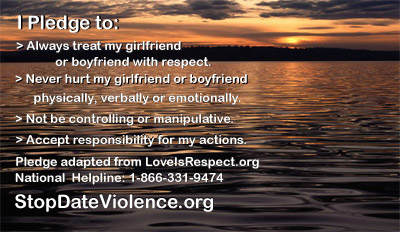
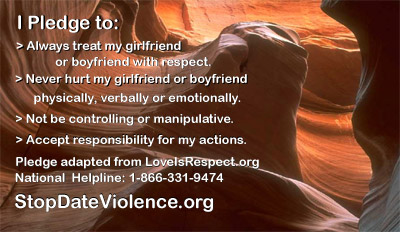
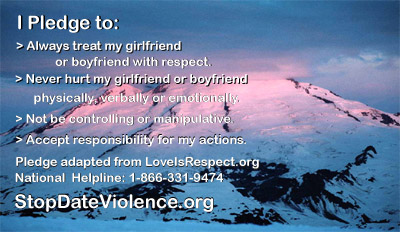
THE DATING PLEDGE
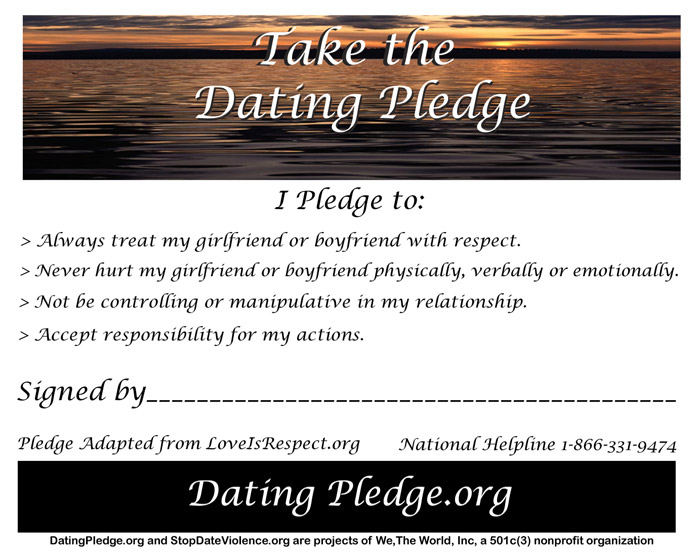
(Adapted
From LoveIsRespect.org - National Teen Dating Abuse Helpline)
Dating
Pledge Cards
More
choices coming soon |
|
How
To Help a Friend Who Is Being Abused
Set
a time to talk. Set aside a time to talk privately with your friend.
Make sure you talk in a quiet place where you won't be distracted.
Let
your friend know you're concerned about her safety. Be honest. Help her
to see the abuse. Tell her about times when you were worried about her safety.
Help her see that what she's going through is not normal and that she deserves
better. Let her know you are concerned about her and want to help.
Let
your friend know you understand she's in a tough situation. Make sure
she knows the abuse is not her fault. Tell her that she is not alone, that she
has many people who love her and care about her. Let her know there is help and
support out there.
Be
supportive. Listen to your friend. Keep in mind that it may be very hard
for her to talk about the abuse. Let her know that you are there to help her.
Don't
place shame, blame, or guilt on your friend. Don't say, "You just need
to leave." Instead, say something like, "I get scared thinking about what might
happen to you."
If
your friend decides to stay, continue to be supportive. She may decide
to stay in the relationship. Or she may leave and then go back to the relationship
many times. It may be hard for you to understand, but there are lots of reasons
people stay in abusive relationships. Be supportive, no matter what your friend
decides to do.
Encourage your friend to do things outside of the relationship, with friends and
family.
Help her make a safety plan.
If
your friend decides to leave, continue to be supportive. Even though
the relationship was abusive, she may still feel sad and lonely once it is over.
Encourage
your friend to talk to someone who can help. Offer to help her find a
local domestic violence agency. If she decides to take this step and get help,
offer to go with her to the agency, to talk to friends and family, to the police,
or to court.
Keep
in mind that you can't "rescue" your friend. She has to be the one to
decide it's time to get help. Support her no matter what her decision.
Let
your friend know that you will always be there no matter what.